
Views: 0 Author: Site Editor Publish Time: 2025-10-30 Origin: Site


When it comes to material handling, forklifts are indispensable tools in many industries. Whether you operate a warehouse, a manufacturing facility, or a construction site, selecting the right forklift is crucial for optimizing productivity and ensuring safety. Choosing the right forklift for your business needs can be a daunting task, given the wide range of options available.
A forklift that meets your needs not only helps in smooth operations but also increases the efficiency of your workforce and protects your valuable assets. However, with so many different types of forklifts to choose from, how do you know which one is the right fit for your business?
In this article, we’ll guide you through the essential factors to consider when selecting the right forklift for your operations. By the end, you’ll have a clear understanding of the key elements that influence your decision and how to choose a forklift that meets your specific requirements.
The first step in choosing the right forklift is understanding the different types available in the market. Each type is designed for specific tasks, environments, and load capacities. Let’s break down the most common types of forklifts:
Electric forklifts are powered by rechargeable batteries and are ideal for indoor operations. They are commonly used in warehouses, distribution centers, and retail spaces where emission control and quiet operation are important.
Eco-Friendly: Since they operate on electricity, they produce no emissions, making them ideal for indoor environments with air quality considerations.
Low Maintenance: Electric forklifts have fewer moving parts compared to internal combustion models, reducing maintenance needs.
Quieter Operation: The lack of an engine makes electric forklifts quieter, which is beneficial in noise-sensitive areas.
Battery Life: While electric forklifts are efficient, the battery needs to be charged, and depending on the model, it may need charging after a few hours of use. Battery charging stations need to be available at your facility.
Lifting Capacity: Electric forklifts are generally better suited for lighter loads compared to diesel-powered forklifts.
IC forklifts run on gasoline, diesel, or liquefied petroleum gas (LPG). These forklifts are robust and are commonly used in outdoor environments or harsh conditions such as construction sites or large warehouses.
Higher Lifting Capacities: IC forklifts tend to have higher lifting capacities, making them suitable for heavy-duty tasks.
Durability: They are designed to perform well in harsh conditions, such as uneven ground or outdoor areas with exposure to the elements.
Longer Run Times: Unlike electric forklifts that need frequent charging, IC forklifts can work for extended periods without refueling.
Environmental Impact: These forklifts produce emissions, which can be a concern in enclosed or indoor spaces without proper ventilation.
Higher Operating Costs: Fueling and maintaining IC forklifts can be more expensive over time compared to electric models.
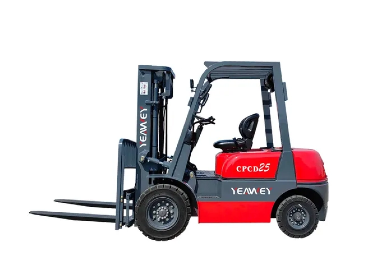
Narrow aisle forklifts are designed specifically for environments with limited space, such as high-density warehouses. They are equipped with specialized masts that allow operators to navigate tight aisles while lifting materials at great heights.
Space Efficiency: They allow for denser storage because they can navigate narrow aisles, allowing businesses to maximize warehouse space.
High Reach: Many narrow aisle forklifts are designed for high stacking, making them ideal for storing goods in vertical space.
Limited Load Capacity: Narrow aisle forklifts often have a lower lifting capacity than larger models.
Specialized Training: Due to the unique operational requirements, operators may need specialized training to handle these forklifts effectively.
Rough terrain forklifts are designed for outdoor operations, particularly on uneven or rough surfaces. They are commonly used in construction, landscaping, and forestry.
Outdoor Use: These forklifts are built with large, durable tires and high ground clearance to handle rough terrain.
Versatility: They can lift heavy materials while working on construction sites, farms, or outdoor storage yards.
Size and Maneuverability: Rough terrain forklifts are typically larger, which can make them less maneuverable in tight spaces.
Limited Indoor Use: Due to their large tires and heavy construction, they are not ideal for indoor environments.
When choosing a forklift, one of the most important factors to consider is its lifting capacity. The forklift’s load capacity refers to the maximum weight it can lift safely. If your business requires lifting heavier loads, you will need a forklift with a higher capacity.
Forklifts come in a range of capacities, from 1-ton to 50 tons or more. For a 1.5-ton forklift, it’s important to ensure that it meets the specific lifting needs of your business. Overloading a forklift can lead to dangerous tipping and equipment damage.
Average Load Weight: Consider the average weight of the materials or goods that you’ll be handling.
Maximum Load Weight: Determine the maximum weight you might need to lift and ensure the forklift can handle it.
Load Center: The load center refers to the distance from the center of the fork to the load's center of gravity. The farther the load is placed from the forklift, the lower the lifting capacity.
The working environment plays a key role in determining which type of forklift is best for your business. Key factors to consider include:
Electric forklifts are better suited for indoor use, as they do not emit fumes. They are ideal for controlled environments, such as warehouses and factories.
IC forklifts are generally more suited for outdoor use, as they are more robust and capable of handling rough terrains.
If you’re operating in a narrow space, a narrow aisle forklift may be necessary to help you maximize storage space and optimize your operations. However, if you have larger aisles or open spaces, a standard forklift may suffice.
For outdoor operations with rough or uneven terrain, a rough terrain forklift would be more appropriate as it is designed to navigate challenging conditions.
The type of power source used by the forklift can impact your decision. Electric forklifts are environmentally friendly and cost-effective, while IC forklifts may be more powerful and versatile but come with higher operational costs and emissions.
Think about the costs associated with refueling or recharging forklifts and whether you need an energy-efficient, low-emission solution or a more powerful option for heavy-duty lifting.
Cost is always a critical factor in any business decision, and forklifts are no exception. While the initial purchase price is important, you should also consider long-term costs such as maintenance, fueling, battery charging, and training.
Electric forklifts generally have lower operational costs but a higher upfront cost due to the price of the batteries.
IC forklifts tend to have lower upfront costs but higher fuel and maintenance expenses.
Consider whether you need to buy or lease a forklift, and compare prices for new versus used equipment.
Forklifts are powerful machines, and safety should be a top priority when choosing one for your business. Modern forklifts come equipped with a variety of safety features to protect operators and workers:
Overhead guards to protect against falling objects.
Anti-tip systems to prevent the forklift from tipping over when lifting heavy loads.
Warning lights or alarms to alert workers in busy environments.
Seat belts and cabs for operator protection.
Make sure the forklift you choose has the necessary safety features for your business operations.
Choosing the right forklift for your business is an important decision that involves understanding your specific needs, workspace conditions, and budget. By evaluating the type of forklift, load capacity, environment, and power source, you can select the best forklift for your operations. Always consider safety features, cost-effectiveness, and long-term operational needs to ensure that you make the right choice.
Whether you need a compact electric forklift for indoor use or a rough terrain forklift for outdoor construction work, understanding your business requirements and forklift options is crucial for smooth operations and efficient material handling. Forklift manufacturers like Qingdao YEAWEY Machinery Co., Ltd. offer a wide range of reliable and high-performance forklifts, designed to meet the diverse demands of various industries. By partnering with a trusted manufacturer, you can ensure that your business operations are supported by top-quality material handling equipment.


